
Hazel Gaze – How Seven Souls Became United, & Reignited by Rock N Roll
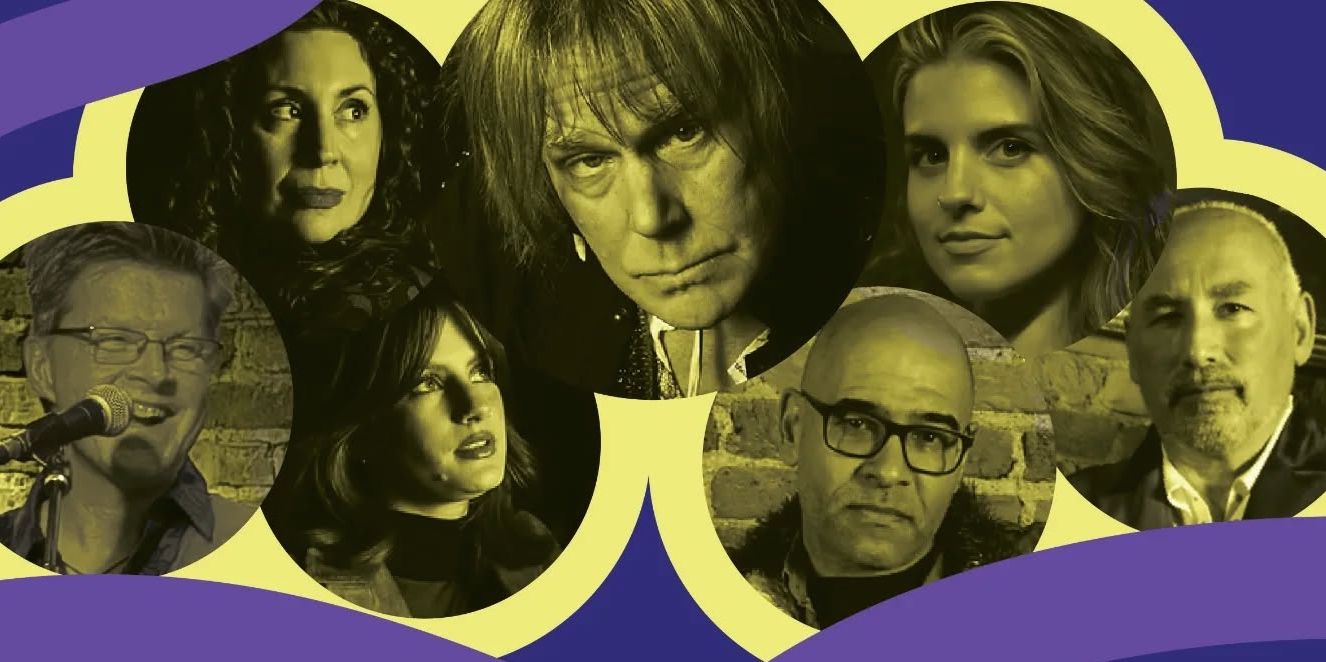
It doesn’t happen often, but once in a blue moon a sequel is even better than the original – The Empire Strikes Back, Terminator 2, and in the case of NYC’s rock scene, Hazel Gaze.
Hazel Gaze released their self-titled debut album in 2017, but when the pandemic hit in 2020 they saw a number of their members choose life in the burbs over the life in the city.
Rather than call it quits, the remaining members revamped, and reloaded, creating the seven-person lineup they have today, which consists of (photo L to R) Russ Soper (guitars / backing vocals), Mary Jo Verruto (keys / backing vocals), Molly Klein (backing vocals / percussion), Hanz (lead vocals), Konrad Payne (bass), Nicole Riolo (backing vocals / percussion), and Spiros Arnakis (drums).
In 2024 that lineup recorded and released Hazel Gaze II, and every time they hit the stage and perform the songs – which have classic rock, and blues influences – the crowd lets the band know how much they love the sequel.
Russ remembers after one show, “I had three different people come up to me, and I’d never met them before … they came up, and said, ‘You guys look like you were absolutely having a blast with each other, and you really get along.’ That, to me, is the most unique thing about this band that I take away – the relationships.”
Having a blast is also a core element of Hazel Gaze, as Hanz says they have one goal when they hit the stage, “We want y’all to have fun.”
Nicole seconds this, adding, “It’s one thing to be moved by a performance, but it’s another thing to walk away and feel a buzzing from that show as an audience member.”
Still buzzing from seeing them at Arlene’s Grocery last month, I caught up with four members of Hazel Gaze to find out more about their backstory, as well as how the band’s unique mix of generations and musical backgrounds has influenced them as musicians, and why they’re looking forward to getting a little Strung Out this summer.
Alright, everyone introduce yourself by saying your role in the band, and telling readers about a musical project you were in before Hazel Gaze that was totally different from it.
Russ: I’m the guitarist. Another musical project (I was in) was a cover band called Instant Karma. We did everything from bars, to corporate events, to weddings, and all that kind of stuff for many, many years.
Hanz: I started out life in a hair band. It was called Z Toyz. We had a video on MTV in the ‘80s.
In the ‘90s I got out of it, and thought I was done. Then I got a call from Dee Snyder, who I was friends with from the hair band days, and I joined a Halloween rock orchestra called Van Helsing’s Curse that was sort of a Halloween version of Trans-Siberian Orchestra, and actually had some of the same players in it as TSO.
Nicole: I am one of the backup vocalists. I took quite a hiatus (from music) for years. I went to a music school, and we did a lot of bands within our classwork itself, but other than that I never joined a band. I never was part of anything outside of Hazel Gaze.
So this is your maiden voyage.
Nicole: Yeah. Truly, though, they have brought me back to life, back into my singing roots. It’s been really, really wonderful.
Mary Jo: I came from mostly solo work.
I’m the keyboardist for this band. It’s my first band, my first official band, besides like school band in high school. I did jazz band, and it was not jazzy at all on my end.
I went to school for musical theater, so I did a lot of performing, and then solo performing when my daughter was a baby. I was a children’s performer for a while. I did this Mary Jo Poppins persona, and I played guitar. Then I wrote my own solo show, so I incorporated a lot of storytelling, and music, and playing solo piano.
I work at the Brooklyn Conservatory of Music where Russ is still an honorary member. He was the chair of the board. I would run into him, and he finally roped me in to loosening up a bit from my classical roots, and just have some fun, and that indeed I am.
You’ve lead beautifully into my next question, which is how did these seven disparate musical souls came together to form Hazel Gaze?
Russ: Hanz and I have known each other for a while – 15, 20 years?
Hanz: Yeah, over 20 years.
Russ: We met through my wife, actually. My wife knew Hanz through a nonprofit that she would volunteer at, and she came home one day, and said, “Hey, there’s this guy really cool. He’s a musician. I heard some stuff. It’s great.”
So she connected us, and we became friends, then we started playing together eventually.
A few of us, as Mary Jo mentioned, have relationships with the Brooklyn Conservatory of Music. Konrad is now a board member there. I met him at that point.
Then Molly, who’s not here, when we were doing the second album, a lot of which was written, drafted, and demoed during COVID, a lot of the band members had moved away, so we started looking for new band members. I posted on Facebook, “New York City Musicians Wanted,” and Molly responded.
She has a lifelong connection with Nicole.
Nicole: I did dance with Molly since I was like nine years old, and she and I were always the music ones of our friend groups. We kind of went our separate ways a little bit in high school, but always stayed friendly.
I think she posted on Instagram that you guys needed another vocalist, and I was like – I don’t have time, but I think I need to do this. I think I need this in my life.
So I reached out, and I auditioned, and I was like, I’m so rusty, they are not going to take me.
Hanz: Did you really feel that way? The first time?
Nicole: God, yeah. I was like, I haven’t done this in a hot minute.
Hanz: Wow. Did not sound that way. I’m not kidding.
Molly, Nicole, and MJ can just pick harmonies out of the air. I struggle to do that. I got to really think about it.
The chemistry I felt was there, even from the audition, it was like – this is a slam dunk.
The bill you were on the night I saw you at Arlene’s Grocery included bands that were super young, and bands that had members that were Gen X. Something I noticed is that during your set the entire crowd, regardless of who they were there for, was having a blast. Why is it that classic rock, and specifically your brand of classic rock, is able to hook audiences from so many different generations?
Hanz: I think the people in my generation that grew up with it, we wear our influences on our sleeve, so it’s not a mystery who our influences are, but I also think when you get down into Gen X, and millennials, their parents listen to that stuff. So many of them say, “Yeah, my dad listens to that stuff,” you know?
Mary Jo: When you’re at The Bitter End, you can have under 21 come, and (when we performed there) I sucked my daughter into coming with her best friend.
She’s 15, rolling her eyes. She calls my band Boomer Band, even though none of us are boomers. But she came, and at the end I saw her like bopping, you know, in the audience. She looked like a little fan. She had like stars in her eyes, and was like, “Mommy, that was great.”
And now that’s going to be in print, so your daughter can’t deny it!
With such a wide age range in the group, and such a diverse set of musical backgrounds, what’s something you now love music-wise, or do performance-wise that is a direct influence from being in Hazel Gaze?
Hanz: For me, it’s reinvigorated a love of harmonies. I mean, I’ve always liked them, but this is the first band where big, giant harmonies have been central to the band’s sound.
I think it’s due not just to the songwriting, and the recording, it’s due to the chemistry with the vocalists on stage. They’ll come up with stuff that’s not on the album, and we’ll decide – oh, yeah, we got to do that!
Mary Jo: I’ve gotten the stick out of my butt, because I was classically trained as a pianist, and Russ, when he first asked me (to be in the band), I was like, oh, I don’t do rock. But it’s like, I actually do.
I love rock. I love playing rock, but I have always put on these horse blinders that I’m classically trained, everything’s black and white. I’ve really loosened up, and these guys have helped me do that. I feel like I can call myself a musician in a way I wouldn’t let myself do so before, and it’s actually opened me up to recording my own solo music that I’ve only talked about recording all this time. So it feels good.
Nicole: I always wanted to think very technical about the music theory behind a harmony working, because that’s what I came from. I came from a conservatory, how do progressions work together, and the theory behind it.
I came in being like, where are their charts? Are we going to follow any kind of charts? And (Hanz is) like, “No, we’re just going to play it.”
So between hearing harmonies, and also hand percussion – something else that I was like, I don’t know if I could keep up with this – that’s totally given me a whole new sense of rhythm.
Russ: I was going to say vocal harmonies, as well. That was very intentional. A very intentional thing to this band was to be a little different.
Hanz and I discussed this a lot. I wasn’t terribly interested in being, you know, just guitar, bass, drums. Three, four guys playing rock n roll, you can go in any place around the world and see that at every bar. I’ve kind of been there, done that, and I really thought this had the potential to be something different, not only musically, but with the lineup, be a little bigger, definitely wanted keys, definitely wanted a lot of vocals.
I love the interplay of men and women in the same band, that brings different perspectives, different personalities, different visuals. I think it’s a little distinguishing. If you go into your average club, you might see three, or four bands. Hopefully we sound a little different, and look a little different.
The second thing I would say is having fun with it. Most of my career, and even in former bands, stuff is very, I don’t want to say perfectionist, but it was very driven, and this is, as well, we try and do things well, we try not to half-ass things, but I think there’s an element of fun in this.
I’ve never been in a situation in my entire life like this, where there are no egos, everybody gets along. Everybody’s good at what they do, but more importantly, everyone is just a really nice person, and I look forward to hanging out with these six people.
What do you have in the works for the summer, and the rest of 2025?
Russ: On July 26th we’re going to be doing an unplugged gig at the Brooklyn Conservatory.
Very much on a 1990s MTV Unplugged vibe, we’re going to decorate the room with candles, and it’ll be really very ethereal, and all that.
We’re going to be accompanied by an orchestral string ensemble, so violins, and cello, and violas, so it will be very different interpretations of all the songs, and it’s going to be recorded, both video, and audio.
So it’ll be a live unplugged … what did you call it, Unstrung in New York album?
Hanz: Strung out. Strung Out in New York City, or Strung Out and Unplugged.
Russ: Yeah, there you go. That will be the next album, the live unplugged album.
Very cool. Now, finally, rock music has been in a bit of a stasis for the past 20 years. The same bands have ruled radio pretty much the entire time. What do you think needs to be done for rock music to grow, and what kind of potential growth most excites your curiosity?
Russ: Well, this is probably not going to be the most artistic answer in the world, but as someone who is in technology, and music … there’s a lot of data around how people that were popular in the early 2000s have remained popular because they were the popular artists, and it’s not just rock, it’s Beyonce, etc.
When the streaming algorithms were implemented, it’s just like with a YouTube video – if you Google something, and you see two videos that tell you how to change a tire, one’s got 50 views, and one has five million views, which one are you to click on?
So the algorithms have kind of reinforced who is popular, and that has been tough for new artists of any genre to break through unless there’s some real compelling event.
I also think the challenge is now there’s so much great music out there, but you have to search for it. Whereas before it was kind of curated for you by an industry. Now there’s what, one hundred thousand songs loaded to Spotify every day? There's more music now than ever, but it’s really on you to find it, and if you want to put in some effort, there’s amazing things to find.
For more Hazel Gaze, check out hazelgaze.com.
Comments